
Land Conservation Process
Ka‘Ina Hana Mālama ‘āina
Land conservation proposals undergo a thorough process that involves several phases. Initially, the City and County of Honolulu Department of Housing and Land Management (“DHLM”) processes each proposal, which is then reviewed by the CWNL Advisory Commission. Following review, the Honolulu City Council must approve the proposal for funding. These proposals are complex conservation transactions and typically require two to three years to progress from initial inquiry to closing.

1
PHASE 1
Proposal Inquiry & Qualification
Community organizations, nonprofits, government partners, and other interested parties begin by submitting an initial proposal inquiry. The Conservation Office (“CO”) staff works closely with applicants to evaluate whether the proposal meets the purposes of the CWNL Fund, identifies potential due diligence concerns, and assists in preparing a proposal for Commission review.

Key: Rectangle = Responsible Party / Oval = Action
2
PHASE 2
Proposal Review & Approval
The Commission considers qualified proposals submitted it to by the CO and submits recommendations to City Council for approval of expenditures from the CWNL Fund.

Key: Rectangle = Responsible Party / Oval = Action
3
PHASE 3
Negotiation & Closing
Following Commission and City Council approval, DHLM CO conducts formal due diligence and enters into negotiations with the landowner or partner entities, typically resulting in the City’s acquisition of a conservation easement (CE) or fee simple title of the property.
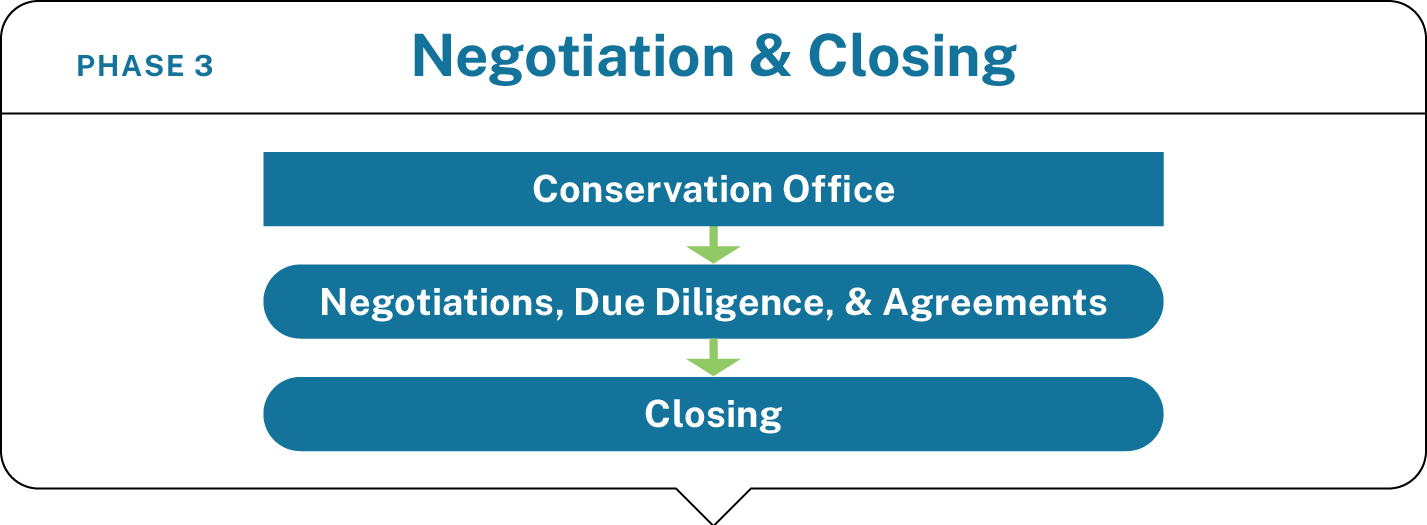
Key: Rectangle = Responsible Party / Oval = Action
4
PHASE 4
Perpetual Stewardship
Post acquisition, the new landowner, whether a designated land trust, partner organization, or the City itself, is responsible for the perpetual stewardship of the land according to the acquisition's conservation values. The CO also conducts annual site monitoring visits for all CWNL-funded sites to ensure the preservation of each site's specific conservation values.

Key: Rectangle = Responsible Party / Oval = Action
Frequently Asked Questions
Have questions? Take a look at the FAQ or reach out anytime:
-
Any qualified organization is eligible to apply. A qualified organization can be a private organization, land trust, or non-profit organization, or government entity.
Part of the application requires the applicant to provide organizational information (such as its Articles of Organization and Bylaws), Mission Statement, and sometimes financial statements and management structure are requested to demonstrate the applicant’s experience and proven ability to steward the proposed property. -
Please fill out our inquiry form and we will schedule a meeting with you.
-
The purpose of the inquiry form is to gather preliminary information on your site of interest, its conservation values, and the intended structure for the acquisition (i.e., who will be the future landowner and steward, conservation easement holder, etc.). Once the inquiry form* is filled out, we will schedule a meeting with you where we can exchange questions as well as provide you with more details and expectations of the proposal process.
*Please note the inquiry form is non-binding and does not bind either the Applicant nor the City to proceed with the proposal. Rather, it is a starting point to ensure applicants have all the information needed to move forward with submitting a full Proposal Application. -
The timeline from [Phase 1] Proposal Inquiry and Qualification to the end of [Phase 3] Negotiations and Closing may take 2-3 years but can vary by site as this is a complex real estate transaction. Transactions can take longer due to issues with the title, appraised conservation easement value, environmental survey results, or delays from other funding sources for the acquisition.
-
CWNL is a voluntary conservation program. In order for proposals to be reviewed by the CWNL Advisory Commission, proposals should have:
Acquisition of the site meets one or more of the 7 conservation purposes of the fund and provides a significant public benefit
Willingness from the Seller to sell the property
Applicant and/or co-applicants are from a qualified organization
Proposed future landowner and steward if future landowner will not be the steward
If you have any questions, please reach out to us at conservation@honolulu.gov and a member of our team is happy to work with you.
-
You can find examples of previously approved application proposals by visiting the Past Meeting section on the CWNL Advisory Commission page. The CWNLAC meeting that took place on June 12, 2026 approved the Ke Kīpuka o Kalaeuila and Pu‘uhonua o Wailupe application proposals.
-
Yes! Agricultural values is one of the purposes of the CWNL fund.
To date, the following sites were acquired using CWNL funding for agricultural reasons: Hakipu‘u Lo‘i Kalo, Wahiawa Lands, Turtle Bay Mauka, Maunawili-Palawai, and Sunset Ranch.
-
Per City Charter, up to 5% of the previous year’s deposit may be used for the operation, maintenance, and management of any sites acquired using CWNL Funds.
CWNL stewardship funds are available for sites that have been acquired by the CWNL fund whether that acquisition was for fee simple ownership or a conservation easement. Sites that were not acquired using CWNL funds are not eligible to apply for stewardship funds at this time. -
A conservation easement (“CE”) is a legal agreement— between a landowner and the CE holder, in this case, usually the City and County of Honolulu—that protects a property's natural, cultural, or agricultural features by limiting development, the number of structures, and commercial activities in perpetuity.
For more information, you may wish to review the resouce put together by Trust for Public Lands and Hawaii Land Trust called the Community Guide to Hawaii Land Conservation.